
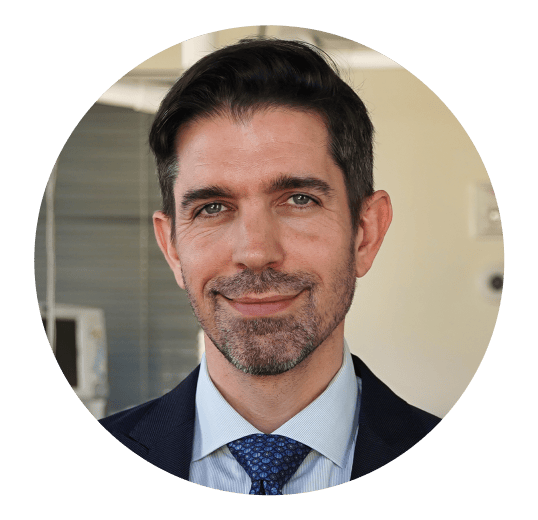
By Dr. Itay Wiser, MD, PhD, Associate Clinical Professor of Surgery at Mount Sinai Elmhurst Hospital, fellowship-trained in aesthetic and reconstructive breast surgery at Lenox Hill Hospital. Medically reviewed September 2026.
There are two broad categories of breast reconstruction after mastectomy: implant-based reconstruction, which uses a tissue expander and then an implant, or an implant directly, and autologous (own-tissue) reconstruction, which builds the breast from your own skin and fat. Own-tissue reconstruction itself includes several flap techniques, of which the DIEP flap from the lower abdomen is one. Neither category is right for everyone. Dr. Itay Wiser, fellowship-trained in reconstructive microsurgery, explains below how the categories differ and where the DIEP flap fits.
Two categories of reconstruction
Implant-based reconstruction places a tissue expander, gradually filled over several visits and later exchanged for an implant, or an implant directly at the mastectomy. Operations are shorter and recovery quicker, and implants need monitoring and eventual replacement.
Autologous (own-tissue) reconstruction moves skin and fat, and sometimes muscle, from another part of your body to the chest to build a breast that is soft, warm and ages with you. Operations and recovery are longer. The main flap options are:
- DIEP flap. Skin and fat from the lower abdomen, moved with its blood vessels and reconnected by microsurgery; the abdominal muscle is preserved.
- Latissimus dorsi flap. Muscle, with or without skin, from the upper back, often combined with an implant.
- Gluteal flaps. Skin and fat from the buttock, used when abdominal tissue is not suitable.
- Thigh-based flaps. Skin and fat from the inner or upper thigh, an option for some patients with limited abdominal tissue.
Which category, and which flap, suits you depends on your body, your treatment plan (especially radiation), and your priorities. The rest of this article focuses on the most common comparison, the DIEP flap and implants.
Who is a candidate for a DIEP flap
- Enough lower-abdominal tissue to build a breast of the size you want.
- Healthy abdominal blood vessels; a previous tummy tuck usually rules the DIEP out, and other flap sites are considered.
- No uncontrolled diabetes, and no smoking, which threatens the flap's blood supply.
- Willingness to accept a longer operation and recovery in exchange for a permanent, natural result.
Who is better served by implants
- Very thin patients with little abdominal tissue.
- Patients who want the shortest operation and recovery, or who need to return to work quickly.
- Patients who have not had and will not need radiation.
- Patients who prefer to avoid an abdominal scar.
How radiation changes the decision
Radiation stiffens and thins the skin. An implant under radiated skin has higher rates of capsular contracture, infection and exposure. A flap brings healthy, unradiated tissue to the chest and tolerates the change far better. For patients who know radiation is planned, surgeons often place an expander at the mastectomy, complete radiation, and then convert to a DIEP flap; for patients who have already had radiation, a flap is usually recommended. Your oncologist and Dr. Wiser plan this together.
Timing: immediate, delayed, or staged
Both methods can begin at the mastectomy (immediate) or later (delayed). Many reconstructions are staged: expander then implant, or flap then nipple reconstruction and fat grafting refinements. The breast reconstruction recovery timeline describes the weeks after each stage.
Why microsurgery training matters
A DIEP flap survives only if vessels a few millimeters wide are reconnected perfectly under a microscope. Dr. Wiser's reconstructive microsurgery fellowship at Lenox Hill Hospital focused on aesthetic and reconstructive breast surgery, and his lymphedema surgery fellowship at Memorial Sloan Kettering Cancer Center addresses the arm swelling that can follow lymph node removal, a concern for many reconstruction patients regardless of method.
Coverage for both
The Women's Health and Cancer Rights Act requires plans that cover mastectomy to cover reconstruction by any accepted method, plus symmetry surgery on the other breast, prostheses and treatment of complications including lymphedema. The breast reconstruction in NYC page explains your rights in detail, and the American Society of Plastic Surgeons' reconstruction overview describes both methods in general terms.
Frequently asked questions
What does DIEP stand for?
Deep inferior epigastric perforator. The flap is named for the blood vessels that supply the lower abdominal skin and fat used to build the breast. Those vessels are carefully dissected out of the muscle and reconnected in the chest under a microscope, so the abdominal muscle is preserved.
Is a DIEP flap the same as a tummy tuck?
The donor site is closed like a tummy tuck, so the abdomen is flatter afterward and there is a low horizontal scar. The purpose is different: the tissue is used to build a breast, not discarded.
Can I have a DIEP flap if I have had radiation?
Often, yes, and it is frequently the preferred choice after radiation because healthy tissue tolerates radiated skin better than an implant does. Timing after radiation is planned with your oncologist.
How long is the hospital stay?
Implant-based reconstruction is usually outpatient or one night. DIEP flap reconstruction involves a hospital stay of a few days for monitoring of the flap's blood supply.
Is either option covered by insurance?
Both. Under the Women's Health and Cancer Rights Act, plans that cover mastectomy must cover reconstruction by any accepted method, including symmetry surgery on the other breast.
Can I switch from implants to a DIEP flap later?
Yes. Conversion from implant reconstruction to a flap, years later, is common when implants have caused problems or the patient prefers her own tissue.
Decide with both options on the table
At the consultation Dr. Wiser reviews your treatment plan, body type and priorities and explains which path he recommends and what would change his mind. His team confirms your coverage in writing.
About the author. Dr. Itay Wiser, MD, PhD is Associate Clinical Professor of Surgery at Mount Sinai Elmhurst Hospital. He completed a reconstructive microsurgery fellowship in aesthetic and reconstructive breast surgery at Lenox Hill Hospital and a lymphedema surgery fellowship at Memorial Sloan Kettering Cancer Center, and holds a PhD in epidemiology and public health. He practices at 535 Fifth Avenue in Manhattan.
Medical disclaimer: This article is for general education and does not replace an individual consultation. Recovery times are typical ranges and insurance criteria vary by plan.