

En Bloc Capsulectomy in NYC: What It Is, Who Needs It, and What to Expect
If you’re considering breast implant removal in New York City, you’ve likely come across the term en bloc capsulectomy. It’s become one of the most searched procedures in the explant community — and for good reason. But not every patient needs it, and not every surgeon performs it correctly.
This guide explains exactly what en bloc capsulectomy involves, how it differs from other removal techniques, and how Dr. Itay Wiser approaches it at his Manhattan practice.
How Long Do Breast Implants Actually Last?
Breast implants are not lifetime devices. According to data collected by implant manufacturers, approximately 50% of breast implants require removal or replacement within 7 years of placement. While some implants remain problem-free for 20 years or more, the FDA recommends that patients with silicone implants undergo MRI screening every 2–3 years to check for silent rupture.
This doesn’t mean every woman with implants will need surgery — but it does mean that implant removal at some point is more common than most patients expect. Understanding your options before problems arise makes the decision easier when the time comes.
This guide explains exactly what en bloc capsulectomy involves, how it differs from other removal techniques, and how Dr. Itay Wiser approaches it at his Manhattan practice.
Take the Next Step
If you’re researching en bloc capsulectomy in NYC and want an honest assessment of whether it’s right for you, breast implant removal consultation with Dr. Wiser is a good starting point. His team can also check your insurance coverage at no cost before your appointment.
Call 347-947-5734 or book a free consultation online.
Dr. Wiser performs en bloc capsulectomy as part of a comprehensive approach to breast implant removal — evaluating each patient individually, reviewing imaging, discussing all technique options, and explaining what outcome is realistic based on your anatomy and goals.
His practice accepts most major insurance plans, including Aetna, Cigna, BCBS UHC and more. Insurance may cover breast implant removal when it is medically necessary due to rupture, capsular contracture, or BIA-ALCL.
What Is En Bloc Capsulectomy?
When a breast implant is placed in the body, the immune system responds by forming a layer of scar tissue around it. This layer is called the capsule. In most cases, the capsule remains soft and causes no problems. In others, it hardens, thickens, or becomes a source of symptoms.
En bloc capsulectomy is a surgical technique in which the implant and the entire surrounding capsule are removed together, as one intact unit — without cutting into or opening the capsule first. The goal is complete removal of all foreign material, including the implant shell, any silicone or saline contents, and the full scar tissue envelope.
The term en bloc comes from French, meaning “in one piece” or “as a whole.”
En Bloc vs. Simple Explant: What's the Difference?
Not all breast implant removal surgeries are the same. Here’s how the main approaches compare:
Simple explant removes only the implant. The capsule is left behind. This is appropriate for patients with no complications, intact saline implants, or minimal capsule involvement.
Partial capsulectomy removes the implant plus portions of the capsule, but not all of it. Used when the capsule is partially calcified or adherent to surrounding tissue.
Total capsulectomy removes the full capsule, but it may be opened or removed in pieces rather than intact.
En bloc capsulectomy removes the implant and the entire capsule together, intact, in a single specimen. This is the most complete removal technique and requires greater surgical skill, a longer incision, and more operative time.
The right approach depends on your implant type, symptoms, imaging findings, and surgical goals — not on personal preference alone.

Who Is a Candidate for En Bloc Capsulectomy?
En bloc is not necessary for every patient seeking implant removal. Dr. Wiser recommends it in the following situations:
Ruptured silicone implants. When silicone has leaked, keeping the capsule intact prevents further dispersal of silicone gel into surrounding tissue during removal.
Breast implant illness (BII). Many patients experiencing systemic symptoms — chronic fatigue, brain fog, joint pain, hair loss — choose en bloc to ensure complete removal of all implant material. While research on BII continues to evolve, complete capsule removal is widely considered best practice for these patients.
Textured implants. Textured implants have been associated with a rare lymphoma called BIA-ALCL (Breast Implant-Associated Anaplastic Large Cell Lymphoma). En bloc removal is the recommended surgical approach for these cases.
Severe capsular contracture (Baker Grade III–IV). When the capsule is significantly hardened, distorted, or symptomatic, complete removal is typically indicated.
Patient preference for complete removal. Some patients, regardless of clinical indications, prefer the peace of mind that comes with total removal of all implant-related material.
If none of the above apply, a simpler approach may be equally safe and appropriate — and Dr. Wiser will be transparent about which technique is right for your specific case.
When En Bloc Capsulectomy Is NOT Necessary
En bloc has become the most-searched explant technique, and many patients come to consultations requesting it specifically — sometimes because of online communities where it is presented as the only acceptable approach. The reality is more nuanced.
En bloc is not always the safest or most appropriate choice. In some cases, attempting to remove the capsule entirely en bloc carries greater surgical risk than a simpler approach — with no meaningful benefit to the patient.
Situations where en bloc may not be necessary or appropriate:
Thin or adherent capsule. When the capsule is very thin or tightly adhered to the chest wall or ribs, removing it en bloc risks injury to surrounding structures, including the pleura (the lining around the lungs). In these cases, a careful total capsulectomy in pieces may be safer and equally complete.
Smooth saline implants with no complications. Patients removing intact, smooth saline implants without BII symptoms, contracture, or cancer concerns may not benefit from en bloc over a standard capsulectomy.
Calcified capsules. Heavily calcified capsules are often brittle and cannot be removed intact without significant tissue damage. A modified approach is used in these cases.
Capsule fused to the pectoralis muscle. When the posterior capsule is densely adherent to the muscle, attempting to remove it entirely can cause unnecessary muscle damage and bleeding.
The goal of implant removal surgery is complete removal of all relevant tissue — safely. En bloc is one technique for achieving that goal, not a requirement in every case. Dr. Wiser discusses the appropriate approach for each patient individually, based on imaging, implant history, and anatomy — not based on a single protocol applied to everyone.
What Happens During En Bloc Surgery?
En bloc capsulectomy is performed under general anesthesia, typically on an outpatient basis. Most patients go home the same day.
The procedure involves making an incision — usually in the inframammary fold (beneath the breast) — large enough to remove the implant and capsule as one intact unit. The capsule is carefully dissected away from surrounding breast tissue, chest wall, and muscle without being opened or punctured.
Operative time is typically 2 to 3 hours per side, longer if a breast lift or fat grafting is performed at the same time.
After surgery, a small drain may be placed temporarily to prevent fluid accumulation. Dr. Wiser will provide detailed post-operative instructions tailored to your recovery.
Recovery After En Bloc Capsulectomy
Recovery from en bloc is similar to breast implant removal generally, with some variation based on whether additional procedures were performed.
Most patients return to light activity within 1 week. Swelling and bruising are normal and resolve over 2 to 4 weeks. Strenuous exercise and heavy lifting should be avoided for 4 to 6 weeks. Full healing, including final breast shape and scar maturation, takes 3 to 6 months.
Wearing a supportive surgical bra is important during early recovery to minimize swelling and support healing tissue.

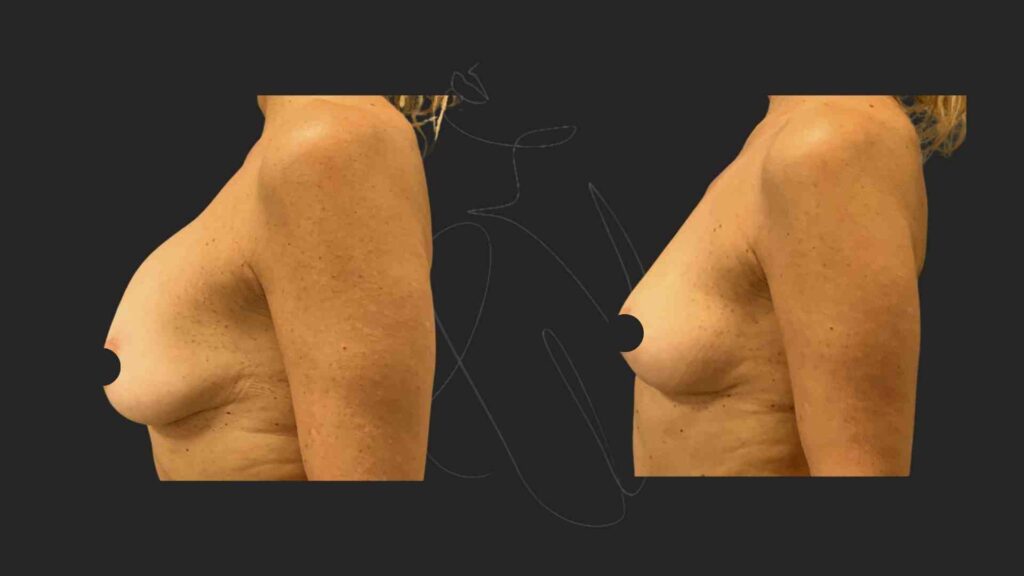
Will My Breasts Look Deflated After En Bloc Removal?
This is one of the most common questions patients ask — and the honest answer is: it depends.
Factors that influence post-removal appearance include the size of the implants, how long they were in place, the amount of natural breast tissue present, and skin elasticity.
Many patients are satisfied with their natural result. Others choose to combine en bloc removal with a breast lift (mastopexy) to address skin laxity and restore breast shape, or with fat grafting to add natural volume without new implants. Both can be performed in the same surgical session.
During your consultation, Dr. Wiser will assess your anatomy and give you a realistic picture of what to expect — with and without additional procedures.
Why Choose Dr. Itay Wiser for En Bloc Capsulectomy in NYC?
Dr. Itay Wiser is a plastic surgeon and Chief of Plastic and Reconstructive Surgery at Mount Sinai Elmhurst Hospital in New York City. He completed advanced training in aesthetic and reconstructive breast surgery at Lenox Hill Hospital and a fellowship in lymphedema surgery at Memorial Sloan Kettering Cancer Center.
Dr. Wiser performs en bloc capsulectomy as part of a comprehensive approach to breast implant removal — evaluating each patient individually, reviewing imaging, discussing all technique options, and explaining what outcome is realistic based on your anatomy and goals.
His practice accepts most major insurance plans, including Aetna, Cigna, BCBS UHC and more. Insurance may cover breast implant removal when it is medically necessary due to rupture, capsular contracture, or BIA-ALCL.
Frequently Asked Questions
Is en bloc capsulectomy covered by insurance?
It may be, depending on the indication. Removal related to rupture, BIA-ALCL, or significant capsular contracture is more likely to qualify as medically necessary. Dr. Wiser’s team verifies coverage before your procedure.
Can en bloc be done if my implants are under the muscle?
Yes, though it is technically more demanding. Subpectoral implants require careful dissection from the chest wall and muscle. This is one reason surgeon experience matters significantly for this procedure.
Do I need an MRI before en bloc capsulectomy?
For silicone implants, an MRI is often recommended to assess for silent rupture before surgery. Dr. Wiser will advise you on necessary imaging during your consultation.
What is the scar like after en bloc removal?
The incision is typically placed in the natural fold beneath the breast (inframammary crease), where it is well-hidden. Scar appearance improves significantly over 12 to 18 months with proper care.